Today’s post comes from Dr. Gellar-Goad, Assistant Professor of Classical Languages
You’ve probably heard this potent rhetorical question somewhere. It’s the slogan behind the famous comics-turned-movie Watchmen[1], it’s the title of an episode of Star Track: Next Generation[2] and of a Hitler novel by Edwin Fadiman[3], and it’s quoted by pundits across[4] the political spectrum[5], often when addressing issues of national security and government powers. It even has its own entry on Urban Dictionary[6], and the Latin original — quis custodiet ipsos custodes? — has a Wikipedia page[7] devoted to it.
It’s like the perfect indictment of Orwellian, 1984-esque Big Brother government, right? If the watchers are the guardians of our republic, who keeps them accountable?
Wrong.
Well, sort of. The Latin quote is real. And the translation is accurate. But what’s missing is the context for the quotation, and it’s a context that might just blow your mind. Content is everything, if you ask the editors of BuzzFeed. But if you ask a classicist, conTEXT is everything.
The context for quis custodiet ipsos custodes is the sixth satire of the Roman poet Juvenal, who wrote in the late 1st or early 2nd century ce. In this extremely long poem, the satiric narrator — a fictional version of Juvenal, sort of like the fictional blowhard version of Stephen Colbert from The Colbert Report — is focused exclusively on Roman women, and how terrible and disgusting and especially how morally and sexually depraved he thinks they are. (Like most ancient men and many modern men, this Juvenal character is a misogynistic pig.)
Our “watchers” line pops up in a discussion about how respectable citizen men’s wives will try to have sex with anything that moves in their house besides their husbands.
The solution? Put guards (custodes, “watchers,” where we get our word “custodian”) at the door. But the wives will just bribe the guards — with sex. So now the watchers are in on the wives’ adulterous adventures. And who will watch the watchers?
So we’re not talking about national security, or big government, or spying or neighborliness or accountability or independent media. We’re talking about a crazy chauvinist’s fear that he can’t trust his No Adultery Task Force because they’re too susceptible to adulterous bribery.
Context kinda changes things, doesn’t it? And the issue of context is crucial not only to the discipline of Classics but also to successful academic work and to better thinking and living more broadly. The nerdiest subgroup of classicists, Philologists, are at core all about the context, asking “what does this word mean in context?” and “how do meanings change based on how words are used in context?”, while any archaeologist will tell you that one of Indiana Jones’ most criminal acts (besides appearing in the fourth film) was removing ancient artifacts from their physical context.
Thinking about context — rather than about quotes or facts or artifacts presented with none of their surroundings or history — leads to a more accurate, more nuanced, and better understanding of things. So when you’re writing a paper or making an argument, watching your evidence isn’t enough. You’ve got to watch the watching, by watching the context, as well.
[1] https://www.youtube.com/watch?v=EaWj2mZsIX0
[2] http://www.imdb.com/title/tt0708844/
[3] http://www.amazon.com/will-watch-watchers-Edwin-Fadiman/dp/B0006C2PS2
[4] https://stallman.org/watchmen.html
[5] http://www.breitbart.com/big-government/2013/06/14/who-will-watch-the-watchers/
[6] http://www.urbandictionary.com/define.php?term=Who+will+watch+the+watchmen%3F
[7] https://en.wikipedia.org/wiki/Quis_custodiet_ipsos_custodes%3F

 Author Hannah Richell once described her writing process as reading a lot, writing a lot, and deleting a lot.
 For today’s Flashback Friday, we wanted to share some of our favorite posts from last fall. All of our previous posts can be found in our
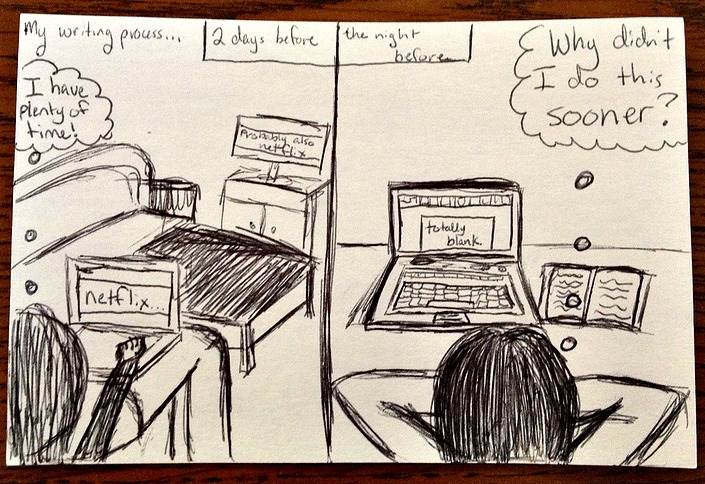 We’ve all been there. Putting off an assignment, thinking we have all the time in the world. And then when we finally sit down to write a paper, obviously at the last minute, we can’t get away from all the techno distractions!
 Our doors unlocked today for appointments at 10am! We will have limited hours this week with our full schedule available soon.
 Whether you’re starting your first week of classes as a first-year student or you’re back for your final year (or a victory lap), we are so glad to have you here for a brand new semester!
 “My time at the writing center has really shaped how I view myself as a writer, and writing in general. Everyone needs to learn how to write well–it doesn’t matter if you’re going into business, science, literature, or something else, being able to clearly express your thoughts to others is a necessity in every field. I came to realize this after encountering numerous students who would, after reading through a paper with me, shrug and say something like, “I’m going into _______ field, so I won’t need writing after this divisional English/First Year Seminar is over.” I wonder where this rumor, that writing is only needed as a correlate to studies that involve reading literature, began? Resumes, job applications, and company memos all require writing, as do scientific research papers. One of the reasons why I love writing is because it is such a flexible skill–you can literally use it for anything. As my senior year comes to a close, I cherish my time tutoring in the writing center because it taught me how valuable writing can be, and how important it is to write well, no matter where you are going in life. Although I am an English major, I am most likely not going to pursue any higher degrees in English studies. However, I know that whatever my future brings, being able to put pen to paper (or fingers to laptop keys) and write with eloquence and clarity will help me along the way.” -Catherine